
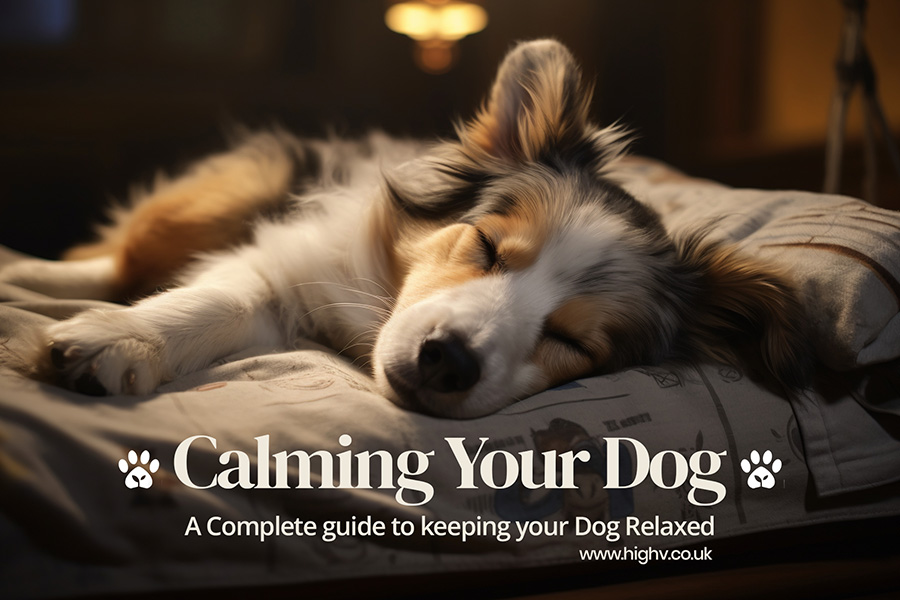
Most advice about anxious dogs is reactive. Something goes wrong, and you address it. Fireworks arrive, so you build a den. The dog reacts on a walk, so you start counter-conditioning. All of it is worth doing, and all of it is downstream of a more useful question: what makes a household one where a dog tends to be calm in the first place?
Because the differences are real and largely observable. Two dogs of the same breed, similar age, similar history, in two different homes, and one settles easily while the other never quite switches off. The variables that separate them are unglamorous — sleep, predictability, the shape of the day, how much of the dog’s exercise is arousing versus regulating — and they are almost entirely within an owner’s control.
This article is about those variables. Owners sometimes use Relaxing Dog Treats to support a dog through a disrupted period, but a household built the right way needs far less intervention, and the structural changes below cost nothing.
Sleep is the foundation
If you change one thing, change this. Adult dogs need roughly 12 to 14 hours of sleep across 24 hours. Puppies need 18 to 20. Senior dogs need more than they did. A great many pet dogs get considerably less, and the deficit is invisible because a tired dog does not look tired — they look busy.
Chronic sleep deprivation in dogs produces exactly the presentation owners describe as anxiety or hyperactivity: poor impulse control, reactivity to minor sounds, an inability to settle, over-arousal in play, mouthing, and a low threshold for frustration. It is one of the most common underlying factors in pet dog behaviour problems and one of the least discussed.
The obstacles are usually environmental. Open-plan living means the dog’s bed is in the middle of the household traffic. Working from home means someone is always moving about. Children mean interruptions. A bed by a window means every passer-by is an event. A dog who wakes twenty times an hour is not getting restorative sleep however long they lie down for.
The fixes are straightforward. Put the bed somewhere genuinely out of the way — a corner, a quiet room, under a table, behind a sofa. Enclose it on at least two sides. Establish an absolute rule that the dog is never disturbed there, and enforce it with children before you enforce anything else. Consider two beds so the dog can choose between the social spot and the quiet one. And build a deliberate quiet period into the middle of the day, particularly for puppies and adolescents, where nothing is happening and nothing is expected.
Predictability beats stimulation
Dogs cannot read clocks but they read sequences with great precision, and a predictable sequence is a nervous system at rest. An unpredictable one is a nervous system on standby.
You do not need a rigid timetable. You need a few reliable anchors: meals at roughly consistent times, a walk that happens whatever else the day contains, a recognisable evening wind-down, and a consistent bedtime. Around those, life can be as chaotic as it needs to be.
The evening routine deserves specific attention because it is the one most households skip. A dog who goes from a busy living room straight to being told to settle has no transition. A twenty-minute wind-down — lights lower, television down, a chew or a lick mat, no games — produces a dog who is asleep rather than a dog who is lying down with their ears up.
Exercise: the arousal question
The default assumption is that more exercise produces a calmer dog. Sometimes. Often the opposite, and this is one of the more useful things an owner can understand.
Arousing exercise — ball throwing, flirt poles, high-speed chase games, rough play with other dogs — is fun and has its place, but it floods the system with adrenaline and cortisol, and those take hours to clear. A dog given forty-five minutes of repetitive ball chasing every day is being conditioned, physiologically, to run at a high baseline. Many owners of “hyperactive” dogs are unknowingly training the state they are complaining about.
Regulating activity — sniffing, foraging, chewing, licking, gentle exploration, problem-solving — lowers arousal. Scent work in particular has a measurable calming effect, and it tires a dog in a way that leaves them settled rather than wired.
A reasonable balance for most pet dogs: mostly regulating activity, some moderate physical exercise, and arousing games in short, defined bursts with a clear end and a wind-down afterwards.
The most valuable walk in most dogs’ week is the one where you go somewhere quiet, let out the lead, and follow the dog’s nose for half an hour without any agenda at all.
Enrichment that actually helps
Enrichment has become a slightly abused word, so it is worth being concrete about what belongs in a calm household.
Chewing is self-soothing. The repetitive jaw action is genuinely regulating, which is why dogs chew when stressed. Provide appropriate long-lasting chews daily, with sensible caution about breakages and about resource guarding if that is a factor.
Licking works similarly. Lick mats with something spread across them are cheap, and useful specifically at the points in the day where you want the dog to come down — after a walk, before bed, during a visitor’s arrival.
Foraging. Scatter feeding a portion of the daily ration into grass or across a mat. Snuffle mats indoors. It costs nothing, uses food you are feeding anyway, and replaces a thirty-second bowl with fifteen minutes of nose work.
Simple problem solving. Cardboard boxes with food folded inside, a towel rolled with treats in it, food puzzles. Keep the difficulty low enough that the dog succeeds — frustration is not enrichment.
Choice. Underrated and free. Letting a dog decide which way to walk, which bed to lie on, whether to greet a visitor or not, and when to stop a training session. Perceived control is one of the strongest buffers against stress in every species it has been studied in.
The human side
Dogs read us closely — posture, breathing, tone, the tension in a lead — and a household running hot tends to produce a dog running hot. That is not a criticism of anyone going through a difficult period. It is a variable worth knowing about, because it means that consciously slowing your own movements and lowering your own voice before a known trigger is a legitimate technique rather than a platitude.
Consistency between people matters too. If one person allows the sofa and another does not, if one feeds from the table and another tells the dog off for begging, the dog cannot predict outcomes, and unpredictability is the thing you are trying to remove. Agree the rules and hold them.
Visitors, doorbells and the front of the house
For a large number of dogs, the calmest household in the world falls apart at the front door, and it is worth handling deliberately because the doorbell happens several times a week.
Give the dog somewhere to go. A bed in another room, a baby gate, a closed door with a chew behind it. A dog who is required to greet every visitor at the door is a dog rehearsing high arousal on a schedule.
Then decouple the sound. Ring your own doorbell twenty times over a fortnight with nobody behind it, scattering food each time, and the bell stops predicting an event. It is a tedious exercise that produces a disproportionate result.
Brief visitors before they arrive rather than as they come through the door. No eye contact, no reaching, no high voices, let the dog approach if they want to. Most people will happily comply if they are told in advance; almost nobody complies if they are told while a dog is jumping at them.
Multi-dog households
Two dogs are not automatically calmer than one, and the arithmetic of arousal works against you. Dogs wind each other up, rehearse each other’s reactions at the window, and compete for the same resting spots.
Separate beds in separate places, so neither has to share a resting area. Individual walks at least sometimes, because a dog who never goes anywhere without their housemate becomes dependent on them. Feed apart. Interrupt play before it escalates rather than after, particularly with a big age gap. And watch that one dog is not permanently on duty managing the other’s behaviour — it is a common and easily missed source of chronic stress.
Managing disruption
Every household has periods that break the pattern: a house move, a new baby, building work, a bereavement, a change in someone’s job, Christmas.
You cannot prevent these and should not try. What helps is protecting the anchors through them. Keep feeding times. Keep the walk. Keep the dog’s bed in a consistent, quiet place even if the rest of the house is in boxes. Give more regulating activity and less arousing activity than usual. Lower your expectations of the dog’s behaviour for a few weeks, because a dog under household stress will be less tolerant, less obedient and more reactive, and that is normal rather than a regression.
Complementary feeds built around ingredients traditionally associated with relaxation are commonly used across periods like these. Sensibly framed, they are a support at the margins while the routine does the substantive work. Introduce anything new gradually, give daily formulations two to four weeks before judging them, and check with your vet if your dog is on medication or has an existing health condition.
What a calm household looks like
Not silent, and not boring. A calm household is one where the dog sleeps deeply for most of the day in a place nobody bothers them, where the shape of the day is recognisable, where most of their activity involves their nose, where they have some say in what happens to them, and where the humans are broadly consistent with each other.
Dogs in that environment are noticeably easier to live with. They settle when guests arrive, they cope better with the unexpected, they recover faster when something goes wrong, and they respond far better to training when training is needed.
It is a slower and less satisfying answer than a product or a technique. It is also the one that does most of the work.

