
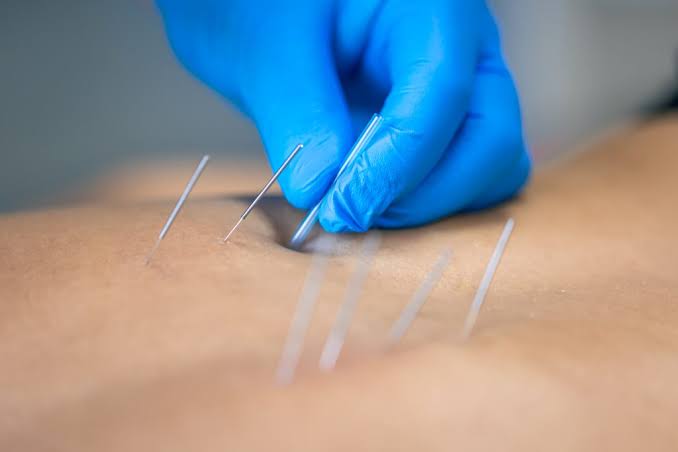
A trigger point is a small, irritable band within a muscle that hurts when pressed and often refers pain somewhere else entirely. A point in the upper trapezius can produce a headache behind the eye; one in the gluteal muscles can send pain down a leg convincingly enough to be mistaken for sciatica. Trigger point therapy delivered through fine-gauge needling targets those bands directly, reaching tissue that pressure applied through the skin often cannot.
What the Technique Involves
A thin filiform needle, similar in gauge to an acupuncture needle and considerably finer than a hypodermic, is inserted through the skin into the taut band within the muscle. Nothing is injected, which is where the term dry needling comes from. The clinician may move the needle slightly to provoke a brief involuntary contraction known as a local twitch response, which is generally taken as confirmation that the intended tissue has been reached.
How It Differs From Acupuncture
The needles look similar and the frameworks are entirely different. Acupuncture selects points according to traditional Chinese medicine theory and meridian pathways. Dry needling selects points according to Western anatomy: the clinician palpates for a taut band, identifies the trigger point within it, and needles that specific structure. Neither is a variation of the other, and practitioners of each train separately.
What It Feels Like
Insertion is usually barely noticeable, since the needle is fine and has no cutting edge. What people report is a deep ache or a cramping sensation when the trigger point is reached, followed by a sudden release as the twitch response occurs. The sensation is distinctive rather than sharp, and it passes quickly. Anyone who finds it uncomfortable should say so during the session rather than afterwards, since depth and technique can be adjusted.
Afterwards
Mild soreness in the treated area for a day or two is common and is comparable to the ache after unfamiliar exercise. Occasional small bruising occurs. Gentle movement, adequate water and normal activity generally help; complete rest tends not to. Most people notice the effect on range of movement fairly quickly, and clinicians usually pair the session with stretching or loading work to hold the change rather than relying on the needling alone.
What It Is Used For
Common applications include neck and shoulder tension in people who work at a desk, upper trapezius and levator scapulae points contributing to tension-type headaches, gluteal and piriformis points producing referred leg pain, calf and hamstring tightness in runners, and forearm points in people who type or grip repetitively. It is used as one component of a broader plan rather than a standalone treatment, and providers of dry needling in Singapore will normally combine it with manual therapy and exercise.
What the Evidence Supports
Research suggests dry needling can produce short-term reductions in pain and improvements in range of movement for myofascial trigger points, with the strongest signal in the immediate to short term. Evidence for lasting benefit from needling alone is weaker, which is exactly why it is best understood as a way of opening a window in which rehabilitation becomes easier rather than as a treatment that resolves a problem by itself. Expect a clinician to describe it in those terms.
How Many Sessions Are Reasonable
There is no fixed number, and a clinic that proposes one before examining you is guessing. A reasonable approach treats a small number of sessions, reassesses against something measurable such as range of movement or a pain score during a specific activity, and makes a decision from there. Many people notice a meaningful change within two or three sessions. If nothing has shifted after that, the working diagnosis deserves revisiting rather than the same treatment being repeated. Be cautious of long prepaid packages agreed at a first visit, since a plan that cannot be revised is not a plan.
Who Should Be Cautious
Tell the clinician if you take anticoagulant medication, have a bleeding disorder, are pregnant, have a compromised immune system, have a pacemaker or implant near the intended area, or have a needle phobia. Needling is avoided over active infections, open wounds and areas of impaired sensation. Over the chest wall and other specific regions it requires particular care and technique. A practitioner should screen for all of this before the first session rather than asking as an afterthought.
When Muscle Pain Is Not the Whole Story
Persistent pain deserves a proper assessment rather than repeated symptomatic treatment. Certain features warrant medical review before any manual or needling therapy, unexplained weight loss, fever, night pain that rest does not ease, progressive weakness or numbness, changes in bowel or bladder function, a history of cancer, or significant recent trauma. These are uncommon, and they are the reason a first appointment should include a history and examination rather than proceeding straight to treatment.
Making It Worthwhile
Needling works best when it is part of a plan that addresses why the tissue became irritable. That usually means loading the muscle appropriately, changing something about the working position or training load that keeps reproducing the problem, and building tolerance over weeks. Used that way, trigger point therapy delivered through fine-gauge needling is a precise tool for a specific tissue problem, and the results tend to hold rather than fading before the next appointment.

