
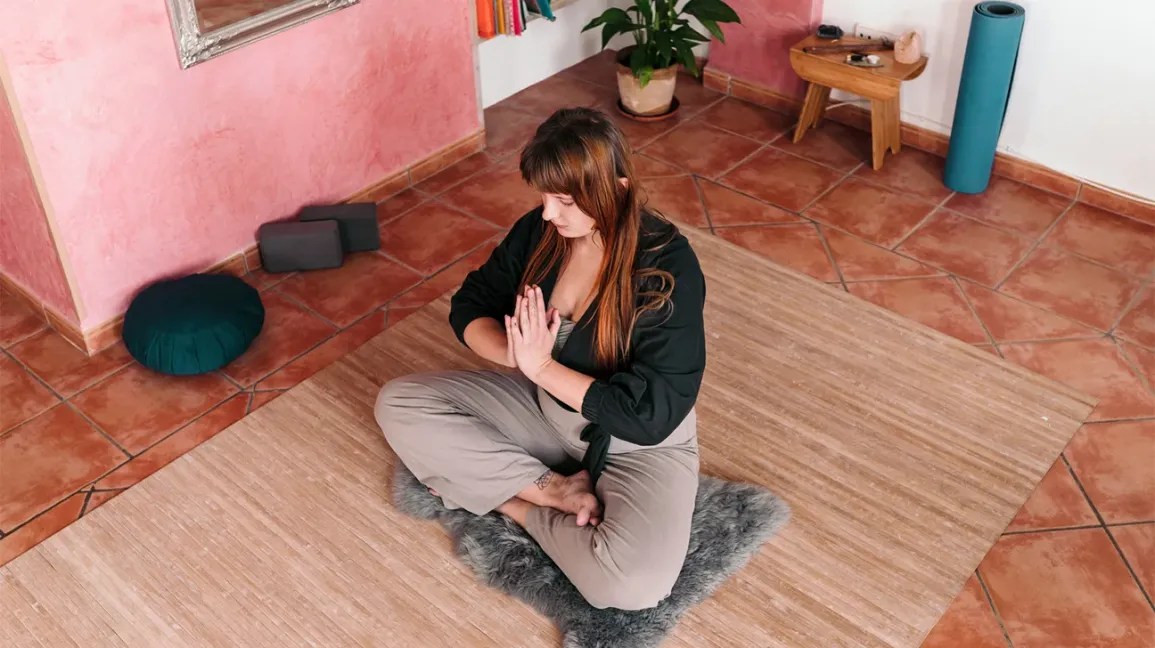
It may appear that the term “yoga” has been equated with contortionist positions, typically executed by individuals with fit, nondisabled, white bodies in picturesque settings — yet this represents only a fraction of the diverse tapestry that this profound tradition encompasses.
When delving into the origin of the term “yoga,” we encounter it’s root in “yuj-,” signifying “to yoke, bind, or connect.” Despite the diverse lineages of yoga, each charting distinct paths and objectives, all variations and schools of yoga are united in their pursuit of a connection to something beyond our individual selves. One could contend that among all the styles of yoga, none is as dedicated to this quest as Bhakti yoga, often referred to as the yoga of devotion.
What Is Bhakti Yoga All About?
Bhakti yoga, often known as the path of devotion or yoga of love, is a journey that nourishes the heart, allowing love to flourish through diverse devotional practices. Renowned Bhakti yoga instructor Nubia Teixeira, author of “Yoga and the Art of Mudras,” beautifully describes this path.” The term “bhakti” originates from the root “bhaj,” signifying “to pray” or “to share.”
Although certain lineages may place a strong emphasis on particular deities or the Divine, in today’s context, numerous contemporary scholars and instructors offer a more expansive interpretation of Bhakti yoga. They define it as the pursuit of unwavering love and devotion that transcends boundaries, extending to encompass everyone and everything.
The Bhagavad Gita, often referred to as “the song of God,” delves into the four paths of yoga, known as the four margas:
1. Karma Yoga, the yoga of selfless service
2. Jñana Yoga, the path of wisdom and knowledge.
3. Raja Yoga, the practice of mastering the mind through Patanjali’s eight-limbed path
4. Bhakti Yoga, the yoga of devotion
It’s important to note that the Bhagavad Gita is primarily centered around Lord Krishna, despite the presence of numerous other deities in Hindu theology. As a result, some instructors turn to the Puranas (composed between 400 and 1500 C.E.) as supplementary and significant texts for Bhakti yoga. The Puranas are believed to comprise 18 texts (although the count may vary depending on the source), each dedicated to different deities.
How is Bhakti yoga practiced?
Interestingly, Bhakti yoga doesn’t require the typical yoga mat or any other equipment – just your heart. While many yoga forms emphasize physical postures (asana) or specific breathwork and meditation techniques, Bhakti yoga incorporates a wide array of contemplative methods and rituals. In contemporary settings, Bhakti yoga classes are often blended with other yoga styles. For instance, you might come across classes like “Bhakti Flow Yoga,” which combines physical poses with Bhakti elements like kirtan meditation (devotional singing) or mantra.
Benefits of Bhakti yoga
Practicing this profound, meditative, and gratitude-invoking form of yoga offers a multitude of advantages. Among the advantages of Bhakti yoga are:
- Elevated Mood
Collective singing and chanting have a well-established link to enhanced emotional well-being and mood.” Recent studies have even shown that online chanting can have positive psychosocial effects, underscoring the power of collective song.
2. Positive Well-being
For decades, research has consistently linked prayer to enhanced subjective well-being among individuals who engage in prayer.
- Stress Reduction
Recent research has connected mantra meditation to reduced stress, although the body of research in this area is somewhat limited. Hatha yoga, a movement-based form of yoga, is also frequently associated with stress reduction, suggesting that hybrid classes like Bhakti Flow or Hatha & Bhakti Yoga may offer similar benefits.
- Enhanced Attention Span
A 2017 study found that praying for an improvement in a situation helped individuals focus less on their worries and bolstered their overall ability to maintain attention on their chosen focal points. Alleviating Pain Interacting with poetry, whether through reading, writing, or listening, has demonstrated associations with pain relief over time. A 2020 research review highlighted poetry’s potentially therapeutic effects, particularly during the recent COVID-19 pandemic.
- Attainment of Bliss
One of the primary objectives of Bhakti practices is to attain “rasa,” described as sheer bliss resulting from the connection with the Divine. While this experience is subjective and requires further scientific investigation, many practitioners have anecdotally reported experiencing this blissful benefit.
The concept of yoga often appears intimidating, with many assuming it involves lengthy, sweaty physical routines. However, yoga is, fundamentally, any action we undertake as an offering. Furthermore, there’s a common misconception that yoga is deeply rooted in religion and centered on God. While Bhakti incorporates a devotional aspect, its ultimate aim is to infuse all our actions with love. From sending goodwill to those facing turmoil worldwide, offering prayers for nearby family members, reciting mantras, adorning an altar with pictures, indulging in your preferred poetry, to practicing self-love — all of these are manifestations of yoga.
 Maintaining health